
Find and Book your local courses
The Link Between Safety Training and Project Efficiency
Safety training and project efficiency are often treated as separate conversations, one belonging to the compliance team, the other to the project manager. In practice, the two are far more connected than that split suggests. Construction safety performance and delivery speed tend to rise and fall together, not independently.
This isn't a coincidence or a correlation that only shows up in aggregate industry statistics. It reflects a simple operational reality: the same underlying competence, understanding risk, following correct procedure, communicating clearly under pressure, is what keeps a site both safe and on schedule. A team that struggles with one is very often struggling with the other too.
This guide looks at why that connection exists, what the data behind it actually shows, and how construction companies can use safety training as a genuine efficiency lever rather than treating it purely as a legal obligation.
Why the Two Are More Connected Than They Look
Every incident, near miss or compliance failure on site carries a hidden cost beyond the immediate safety impact: work stops, investigations begin and schedules slip. A project with strong safety performance rarely wins headlines for it, but it consistently avoids the disruptions that quietly erode programme time on less well-trained sites.
Well-trained teams also make fewer basic errors. A supervisor who genuinely understands risk assessment, rather than one who has simply sat through a course, tends to catch problems before they escalate into rework, delay or a formal incident report.
The Compounding Effect Across a Full Project
None of these individual effects look dramatic in isolation. A single delayed task, one piece of avoidable rework, a morning lost to an investigation, can each seem like a minor, unrelated setback. Across the full length of a project, and across an entire workforce, these small effects compound into a meaningful difference in overall delivery performance.
This is part of why the link between safety and efficiency is easy to underestimate from the inside. No single incident tells the full story, it's only visible when comparing overall project outcomes over time, which is exactly why tracking the right metrics matters more than relying on instinct alone.
How Poor Safety Performance Drains Project Time
The productivity cost of weak safety performance rarely shows up as a single dramatic event. More often, it accumulates through smaller, less visible drains on programme time.
Cause | Typical Impact on Programme |
Incident investigation and reporting | Site or task area stopped pending investigation |
Rework following unsafe or incorrect method | Time and materials cost repeated |
Low morale following a near miss or incident | Reduced productivity across the wider team |
HSE intervention or enforcement notice | Potential full site shutdown until resolved |
What Strong Safety Performance Actually Looks Like on Site
Sites with genuinely strong safety performance tend to share a few common traits: supervisors with up to date SMSTS or SSSTS training, consistent toolbox talks that get used rather than just logged, and a workforce confident enough to raise a concern without it being treated as a disruption.
None of these traits are expensive to build individually, but together they create a working environment where problems get caught early. This is precisely the kind of environment that also tends to deliver against programme more reliably.
It's also worth noting what strong safety performance doesn’t require: it doesn't require slowing work down to an excessive, overly cautious pace. The most efficient sites are rarely the most rushed. They're the ones where competence means fewer things go wrong in the first place, which is a very different thing from simply working more slowly and carefully.
Measuring the Return on Safety Training
The productivity case for safety training is easiest to make with a handful of practical metrics tracked before and after a structured training programme is introduced, incident and near miss rates, rework frequency, and delivery against the original programme.
Businesses that track these consistently tend to find the return on safety training shows up well beyond the initial compliance requirement, in fewer stoppages, steadier momentum, and a workforce that spends more time building and less time recovering from avoidable setbacks.
A practical starting point is simply comparing these figures across two comparable projects, one before a structured training investment and one after, rather than trying to build a complex formal ROI model from day one. Even a rough, directional comparison is usually enough to make the business case clear internally.
Building Safety Into Project Planning, Not Just Compliance
The businesses seeing the strongest results tend to plan training requirements alongside the programme itself, rather than treating it as a separate compliance checklist to work through once mobilisation has already begun. Mapping which certifications and refreshers a project will need, and by when, avoids the common scenario where a key supervisory role sits uncertified right when the project needs it most.
This kind of forward planning also gives training providers enough notice to accommodate larger bookings or specific scheduling needs, rather than scrambling to arrange last minute training once a gap has already started costing time on site.
A Practical Example
Consider two comparable groundworks teams starting similar projects. One has invested in structured SSSTS and refresher training ahead of mobilization. The other relies on a mix of experience and informal on-the-job learning. Over the course of a typical project, the trained team is likely to complete inspections and toolbox talks more efficiently, encounter fewer stoppages caused by uncertified supervisors or missed documentation, and lose less time to preventable rework.
None of these differences are dramatic in isolation, but across a full project programme they typically add up to a measurable difference in delivery against schedule, precisely the kind of gain that's easy to attribute to good management, but which structured safety training makes possible in the first place.
Key Takeaways
• Strong construction safety performance and project efficiency consistently move together, not independently
• Weak safety performance drains programme time through investigation, rework and reduced morale, often invisibly
• Well-trained supervisors catch problems early, reducing the incidents that cause the biggest delays
• Tracking incident rates, rework and delivery against programme gives a practical way to measure the return on safety training
• Planning training requirements alongside the project programme avoids costly certification gaps mid-project
Frequently Asked Questions
Does safety training genuinely improve project efficiency, or is that just a compliance argument?
The evidence points to a genuine, practical link. Well-trained teams make fewer errors and experience fewer incident-related stoppages, both of which directly support smoother, faster project delivery alongside the safety benefits.
How can a construction company measure its own safety performance against efficiency?
Tracking incident and near miss rates, rework frequency, and delivery against the original programme before and after training investment gives a practical, project-specific way to see the connection in your own data.
Which training has the biggest impact on project efficiency?
Supervisory and management training such as SSSTS and SMSTS tends to have the broadest impact, since a well-trained supervisor reduces errors and delays across an entire team, not just their own work.
Is it worth investing in safety training purely for productivity reasons, separate from compliance?
Many businesses find the productivity case stands on its own, fewer stoppages and less rework translate into a measurable time and cost saving, independent of the legal requirement to provide safety training in the first place.
Conclusion
Safety training and project efficiency aren't competing priorities, they're the same priority looked at from two different angles. A site that trains its people properly tends to be the same site that delivers reliably, not by coincidence, but because the same underlying competence drives both outcomes.
Browse accredited safety and supervisory training at Easybook Training.
Get in touch
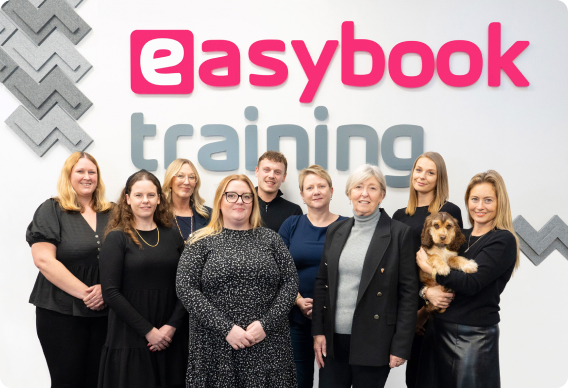
Booking a safety course with Easybook Training couldn't be simpler. We are constantly investing to ensure our online booking system is not only easy to use, but intuitive, so that when you return to book another training course, or add a delegate to an existing booking, this process is as pain free as possible. We're also available seven days a week, and are happy to assist with your enquiry whenever best suits you. As a family-run business we are proud to provide a professional service, with a personal touch; so why not get in touch today.
70,000+ courses
Thousands of courses from hundreds of UK training providers.
UK nationwide
We have venues across the UK, from Aberdeen to Isle of Wight.
No booking fees
We don’t add booking fees, and all major credit cards accepted.
Open 7 days a week
We’re here to help daily, from 8.30am to 7pm.