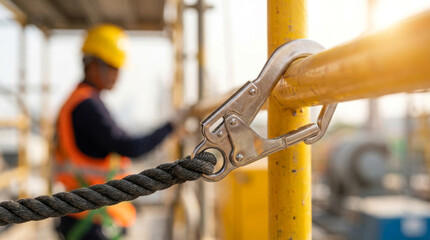
Find and Book your local courses
Preventing Falls on Construction Sites: Training and Best Practices
Falls from height are the single leading cause of fatal injuries on UK construction sites. Year after year, the Health and Safety Executive reports that more construction workers die from falls than from any other cause. In many cases, the falls that cause the most serious harm are not from extreme heights. They are from scaffolding platforms, mobile access towers, ladders and MEWPs at heights where, with the right precautions in place, survival would have been almost certain.
This is what makes fall prevention on construction sites both urgent and achievable. The hazards are well understood. The equipment required to manage them is widely available. The training needed to use that equipment correctly exists and is accessible across the UK. The question is whether the right combination of planning, equipment and training is in place before work begins.
This guide covers the practical steps that prevent falls — from the regulatory hierarchy of control that must be applied, to the specific training qualifications that equip workers and managers to work at height safely.
Why Falls Remain the Biggest Killer in Construction
Understanding why falls remain so prevalent despite extensive regulation helps identify where prevention efforts must be focused.
The most common contributing factors to construction falls include:
Work at height carried out without a risk assessment or method statement in place
Incorrect equipment selected for the task or environment
Equipment inspected inadequately or not at all before use
Workers using access equipment they have not been trained to operate
Supervisors who lack the competency to identify unsafe working conditions
Time and commercial pressure overriding safety planning
The consistent theme across these factors is competency. This is the knowledge and skill to plan, select, inspect and use the right equipment for the right task. That competency is developed through training.
The Legal Framework: The Hierarchy of Control
The Work at Height Regulations 2005 establish a clear hierarchy that must be applied to all work at height. This is not a choice between options. It is a mandatory sequence that must be worked through in order.
Step | Requirement | Construction Example |
1 — Avoid | Avoid work at height entirely where reasonably practicable | Pre-fabricate roof components at ground level |
2 — Prevent | Use collective protection to prevent falls where work at height cannot be avoided | Scaffold with edge protection rather than harnesses alone |
3 — Minimise | Minimise the distance and consequences of a fall where it cannot be prevented | Safety nets below a working platform |
The most common error in applying this hierarchy is jumping to personal protective equipment — harnesses, lanyards — without first considering whether collective protection could eliminate or substantially reduce the risk. Personal fall protection is the last line of defence, not the first.
Equipment That Prevents Falls: Getting the Selection Right
Selecting the wrong access equipment for a task is one of the leading causes of preventable falls on construction sites. The choice of equipment must be based on the specific requirements of the task, not on what happens to be available.
Equipment | Best used for | Key risk if misused |
Scaffold with edge protection | Extended work at height, perimeter access | Incorrect assembly or inadequate inspection creates structural failure risk |
Mobile access tower (PASMA) | Indoor or outdoor short-duration access, maintenance | Incorrect assembly or overloading causes collapse |
Cherry picker / boom lift (IPAF 3b) | Outdoor access to elevated structures, outdoor construction | Overturning on uneven ground, entrapment, collision |
Scissor lift (IPAF 3a) | Vertical access, indoor high-level work | Travelling at height without correct training, collision |
Ladder | Short-duration light work, access only | Over-reliance for tasks requiring two-handed work or sustained height |
Safety harness and lanyard | Restraint or arrest where collective protection not possible | Incorrect fit, incorrect anchor point, suspension trauma |
The Training That Makes the Difference
The most effective prevention of construction falls comes from ensuring that every person who works at height — and every person who supervises or manages that work — holds the training appropriate to their role and the equipment involved.
IPAF Training — Powered Access Equipment
Anyone operating a Mobile Elevating Work Platform (MEWP) on a UK construction site is expected to hold a valid IPAF PAL card for the relevant equipment category. This is not a legal requirement in the same way a driving licence is. However, it is widely required by employers and principal contractors as a condition of operating MEWPs, and it is the recognised standard of competency.
IPAF covers equipment categories including:
Category 1a — static vertical platforms (e.g. scissor lifts used in fixed positions)
Category 1b — static boom lifts (self-propelled booms with outriggers, vehicle-mounted platforms)
Category 3a — mobile scissor lifts (travelling at height)
Category 3b — mobile boom lifts and cherry pickers (travelling at height)
Most construction site MEWP operations require Category 3a and/or 3b. Training covers pre-use inspection, safe operation, emergency procedures and rescue planning. The PAL card is valid for five years.
PASMA Training — Mobile Access Towers
Mobile aluminium scaffold towers are among the most commonly used access solutions on construction and maintenance sites, and incorrect assembly is one of the most common causes of tower-related falls. PASMA training covers the correct assembly, alteration, dismantling and inspection of mobile towers in accordance with the manufacturer's guidance and the relevant Code of Practice.
PASMA training is required for anyone who assembles, alters, dismantles or supervises work on a mobile access tower. The PASMA card is valid for five years.
SMSTS and SSSTS — Management Competency
Preventing falls is not only the responsibility of the workers using access equipment. It is the responsibility of the managers and supervisors who plan the work, specify the equipment and oversee the process. SMSTS qualifies site managers to fulfil their legal duties under the Work at Height Regulations, including planning, risk assessment and emergency procedures. SSSTS equips supervisors to monitor safe working and identify and correct unsafe conditions before they lead to incidents.
Pre-Work Checklist: What to Verify Before Any Work at Height Begins
Before authorising any work at height on site, the following must be confirmed:
A written risk assessment has been completed specific to this task and location
A method statement specifying the access equipment to be used is in place
The equipment selected is suitable for the specific task and environment
All workers involved hold valid certification for the equipment being used
The equipment has been inspected before use and the inspection recorded
Edge protection, barriers or exclusion zones are in place where required
An emergency and rescue plan has been communicated to the team
Weather conditions have been assessed — wind speed in particular for tower and platform work
Inspection — the Step Most Often Skipped
Equipment failure is a significant contributor to falls on construction sites, and equipment failure is almost always preceded by inadequate inspection. The Work at Height Regulations require that access equipment is inspected:
Before use after assembly in a new position
After any event that could affect stability — high winds, a collision, suspected overloading
At regular intervals determined by the risk assessment, typically at least every seven days for scaffolding
Pre-use inspection is a skill. Workers trained in IPAF and PASMA learn what to look for during inspection — damaged components, missing pins, unstable ground conditions. Without this training, an inspection may be completed on paper without identifying the fault that causes a fall.
Frequently Asked Questions
What is the most common type of fall on a UK construction site?
Falls from scaffolding, mobile access towers and ladders account for the largest number of fall-related injuries. Falls from MEWPs are less common in volume but often result in more serious injury due to the heights involved. All three categories involve equipment that requires specific training to use safely.
Do I need IPAF training to use a cherry picker on site?
IPAF is not a statutory legal requirement in the same sense as a driving licence, but you must be competent to operate a MEWP. Most employers and principal contractors require a valid IPAF PAL card as evidence of competency. Operating a cherry picker without appropriate training significantly increases the risk of a serious incident and creates substantial liability for the operator and their employer.
Can ladders still be used on construction sites?
Yes. Ladders are still a legitimate access method where the risk assessment confirms they are appropriate. typically for short-duration, low-risk tasks. The Work at Height Regulations require that alternative equipment is considered before using ladders, and that where ladders are used, they are the right type for the task, correctly positioned and secured where necessary.
How do I know if my IPAF or PASMA card is still valid?
Both cards include an expiry date. IPAF cards are valid for five years from the date of issue. PASMA cards are also valid for five years. Refresher training is required before expiry to maintain the certification. Most site management software or HR systems can be set to flag upcoming expiry dates. This proactive renewal is preferable to discovering an expired card at a site induction.
Conclusion
Falls from height are the most preventable category of serious injury on UK construction sites. The regulations, the equipment and the training all exist to eliminate or substantially reduce this risk. What prevents falls is the consistent application of all three — a hierarchy of control that is genuinely followed, access equipment that is correctly selected and inspected, and a workforce and management team with the competency to work at height safely.
For individual workers, IPAF and PASMA are the qualifications that demonstrate competency for the equipment most commonly involved in falls. For site managers and supervisors, SMSTS and SSSTS provide the management frameworks to create the conditions where falls are prevented before they happen.
Get in touch
Booking a safety course with Easybook Training couldn't be simpler. We are constantly investing to ensure our online booking system is not only easy to use, but intuitive, so that when you return to book another training course, or add a delegate to an existing booking, this process is as pain free as possible. We're also available seven days a week, and are happy to assist with your enquiry whenever best suits you. As a family-run business we are proud to provide a professional service, with a personal touch; so why not get in touch today.
70,000+ courses
Thousands of courses from hundreds of UK training providers.
UK nationwide
We have venues across the UK, from Aberdeen to Isle of Wight.
No booking fees
We don’t add booking fees, and all major credit cards accepted.
Open 7 days a week
We’re here to help daily, from 8.30am to 7pm.